
If you’re breastfeeding and thinking about getting back into exercise, you might be wondering, "Will working out hurt my milk supply? Will my baby refuse my milk? Do I need to pump and dump after a workout?"
The short answer: Exercise is safe, healthy, and does not harm your breast milk. In fact, regular movement can support your overall well-being, which is a big win for both you and your baby. Let’s break down what really happens when breastfeeding moms exercise.
Good news: Moderate exercise does not reduce milk supply.
Milk production is driven by supply and demand — how often milk is removed from your breasts. As long as your baby is nursing regularly or you’re pumping consistently, your body will continue making the milk your baby needs.
Multiple studies back this up:
-
A large population study found that breastfeeding mothers who exercised had no reduction in milk volume or infant growth, showing that physical activity does not interfere with breastfeeding success.(3)
-
Clinical trials comparing active and sedentary breastfeeding mothers found no difference in milk production or composition.(2)
- Another study concludes that moderate physical activity does not compromise milk volume, nutrient content, or infant growth. Breastfeeding and exercise are fully compatible.(1)
So if you are a mama who loves her exercise (or just wants to take care of your body), you have nothing to worry about. As long as you’re eating enough, staying hydrated, and nursing or pumping regularly, exercise itself will not lower your supply.
Does Exercise Change the Taste of Breast Milk?
You may have heard that working out can make your milk taste sour or cause your baby to refuse it. This idea comes from older research looking at very intense exercise.
A study found that very intense workouts can temporarily increase lactic acid levels in breast milk. As you can probably imagine, more acidic milk might taste a little funky to a baby. Researchers observed that a few babies were less interested in milk expressed immediately after intense exercise.(4)
However, this slight reluctance to take breast milk after exercising was only seen for mamas that had just completed a very intense workout. The same behavior was NOT observed for light or moderate exercise. In fact, moderate exercise does not significantly change breast milk flavor at all.
What this means in real life:
- Most babies never notice any difference.
- Any change is short-lived.
- There is no harm to your baby.
- You do not need to pump and dump. Your milk is still perfectly healthy, even if you've had a particularly intense workout.
If you ever notice fussiness after a very intense workout, waiting 30–60 minutes before feeding is optional — but for most moms, it’s unnecessary.
Does Exercise Change the Nutritional Quality of Breast Milk?
Short answer: NOPE! Not a bit! Breast milk remains nutritionally complete even when moms exercise. Your milk continues to provide exactly what your baby needs.
Tips for Exercising Comfortably While Breastfeeding
The biggest challenge with postpartum workouts is usually comfort — not milk supply. If you've ever tried to run or do a set of pushups with engorged breasts, you know exactly what I'm talking about. Here are some tips to make exercising more comfortable for the breastfeeding mama:
Tip #1: Nurse or pump right before your workout.
This helps reduce fullness, pressure, and leaking.
Tip #2: Wear a supportive sports bra.
A good sports bra will have:
- High support
- Adjustable straps
- Breathable fabric
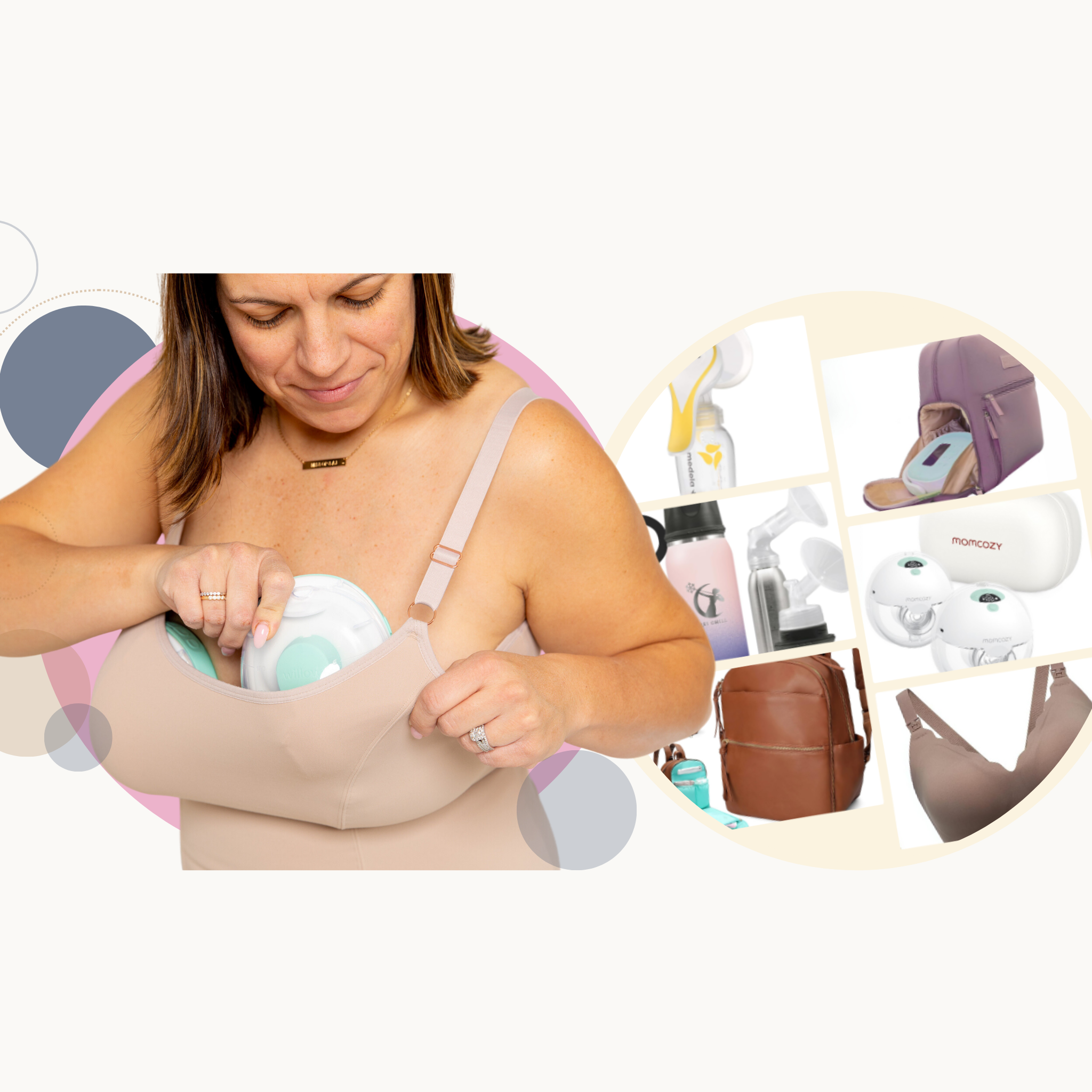
Avoid overly tight compression bras that can contribute to clogged ducts. Need some ideas? I have an entire video series reviewing nursing and pumping bras. Included in this series are a few sports bras you might want to check out!
Tip #3: Use nursing pads.
Leaking during workouts is completely normal, especially in the early months postpartum. Adding some nursing pads to your bra can keep you dry and avoid some embarrassing wet spots. (Workout time is NOT the time for hard collection cups --- I love 'em, but stick to soft pads for exercise.)
Tip #4: Stay hydrated and eat enough.
Breastfeeding and exercise both increase your calorie and fluid needs. In fact, dehydration or too few calories is more likely to impact milk supply than exercise itself will.
Tip #5: Ease back in to a workout routine.
Walking, yoga, low-impact cardio, and light strength training are great places to start.
The Bottom Line
- Moderate exercise does not decrease milk supply
- Milk nutrition remains stable
- Taste changes are rare and temporary
- You do not need to pump and dump
Exercise supports your physical recovery, mental health, and long-term wellness, indirectly supporting you to be able to nourish your baby exactly as they need. Your body is doing something incredible. You deserve to feel strong while doing it.
----------------------------------------------------------------------------------------
Citations
-
Calcaterra G, Sinigaglia G, Pinti M, et al. Breastfeeding and maternal exercise: A synergistic approach to improve cardiometabolic health. Clin Nutr ESPEN. 2025;70:607-615. doi:10.1016/j.clnesp.2025.10.029
-
Dewey KG, Lovelady CA, Nommsen-Rivers LA, McCrory MA, Lönnerdal B. A randomized study of the effects of aerobic exercise by lactating women on breast-milk volume and composition. N Engl J Med. 1994;330(7):449-453. doi:10.1056/NEJM199402173300701
- Su D, Zhao Y, Binns C, Scott J, Oddy W. Breast-feeding mothers can exercise: results of a cohort study. Public Health Nutrition. 2007;10(10):1089-1093. doi:10.1017/S1368980007699534
- Wallace JP, Ernsthausen K, Inbar G. The influence of the fullness of milk in the breasts on the concentration of lactic acid in postexercise breast milk. Int J Sports Med. 1992;13(5):395-398. doi:10.1055/s-2007-1021287